THE MANIFESTO
For those who want the thought entire.
What the khôra is
In Plato's philosophy, the Khôra (χώρα) names the original receptacle: the ungraspable space that effaces itself, that withdraws, so that creation may come to pass within it. It is pure capacity to receive — it lets form take form and makes every emergence possible.
It is from there that our associative, humanist and cultural project takes its name, its philosophical and artistic line, and its engineering. And it is no accident that this project rises in Marseille — the Phocaean city, daughter of the Greeks who came from Asia Minor twenty-six centuries ago, the first point on the peninsula where the philosophy of Athens set foot. Maison Khôra claims an inheritance there: to bring philosophy back to the heart of the city, at a time when the age would have, more than ever, use for it.
What Maison Khôra brings together holds in two gestures knotted to one another. On one side, a search — philosophical, nourished by living traditions, bearing on the question of being: what is it to exist, what is it to feel, what are we? A search for meaning, and for connection. On the other, facilitated spaces of somatic and relational experiment, where that search ceases to be discourse and becomes experience — with, at their heart, a demand for full awareness: rightness with oneself, rightness with the other. A thought and a practice inseparable from one another, joined by a single art: that of holding space.
Maison Khôra withdraws in order to make room. Its collective of artists of direct experience builds receptacles — facilitated spaces held with rigour — where intimate experience, creation and connection emerge of their own accord. This withdrawal is the very condition of what comes to pass: the gesture of the space holder who holds the frame and leaves the centre vacant, the gesture of all true pedagogy, which creates the conditions for a truth to recognise itself. No doctrine is imposed here: its approach is non-dogmatic, centred on a direct relation to the Mystery — that question which remains, for ever, open.
A humanism — the question of the humanAt bottom, Maison Khôra is a deeply humanist project — a humanism that dares to make the human a question again. An anthropology in the first sense, a search for what it is to be human, conducted through the phenomenological observation of lived experience. The human is observed here where the human gives itself: in a body, in a presence, in the instant when something is felt before being thought.
It is in the fineness of that observation that the paradox which founds us is discovered: the most carnal, the most finite experience is the very place where the infinite lets itself be touched. The senses — those of the body, and the sense a life takes on — are the door to what exceeds us. The question Maison Khôra holds open is the oldest in philosophy, and remains the most urgent: how does the finite make its link with the infinite?
Maison Khôra creates the conditions for each person to live it.
The diagnosis — a moment of singularityWe are living a moment of singularity. The expression names those rare civilisational thresholds where several major transformations converge — where none can be thought without the others, and where the very image of the human is put back into play. Four accelerations, at the least, mark ours.
The deserted interior. The great narratives have collapsed with nothing to replace them: religious institutions no longer hold, ideologies are running out, the promise of material progress has ceased to console. Screens have replaced presence, opinions have replaced conversation, and a question no age had been so able to set aside comes knocking in silence: what am I doing here, and with whom?
The technological singularity. Artificial intelligence is settling everywhere and returns us, whatever our old certainties, to a new question: what are we as consciousness, now that the machine can think without us? Maison Khôra does not flee these tools: it uses them lucidly and under an ethical demand, as an unprecedented access to the accumulated knowledge of humanity — one of the age's chances as much as one of its vertigos. But it holds to the distinction: the machine extends what we know; it will never touch what we are. And it is what we are — presence, the body, encounter — that the house cultivates. To this technological revolution it opposes, as a mirror, an inner revolution.
The geopolitical shift. The world order founded on law is crumbling, empires are returning to the table, the balance of forces prevails over institutions. Wars are relighting where they were thought extinguished, and the century, barely begun, is already giving humanity the experience of a world without a common frame.
The identity fracture. As the ground gives way, identities harden into enemy othernesses. Polarisation fractures the city and makes each person the jealous defender of a narrow narrative. Faced with that logic, Maison Khôra makes the opposite wager: a space where identity itself is held as a living question, and not as a flag.
Faced with this manifold vertigo — of having been thrown into the world together with no instructions, and of having, now, to redraw what it is to be human — Maison Khôra sets itself a task serving the public interest: to put the experience of what exceeds us, and the bond that holds us, back at the heart of the City.
The approach to the MysteryA part of the West long confused the question of the Mystery with that of a God, and the question of God with that of the religions of the Book — as though the ineffable had no face but the one a particular tradition lends it. This is an impoverishment, and one of the sources of the age's spiritual fatigue: an identitarian and anthropomorphic God has been driven out, leaving in his place nothing but a void.
Other ways, everywhere in the world, approach what exceeds us differently. The non-dual traditions in particular — those of Asia, but also those the ancient Mediterranean carried before they were covered over — hold that identity itself is an appearance, that the separation between self and world is a surface effect, and that the real lets itself be approached as a weave, as an emergence, as an emptiness that is at the same time a fullness. All is empty, all is full. That cosmology is non-identitarian: it asks belonging to nothing, and this is what makes it, paradoxically, a way of welcome for everyone.
Maison Khôra takes note of this common deposit. The Mystery, here, is no one's monopoly: there is an ineffable, and a thousand ways of entering into relation with it. The house sets itself the task of transmitting the intellectual and bodily equipment that allows those thousand ways to recognise one another — an ecumenical curriculum, open to all practices of consciousness — and then of creating the conditions in which, after the curriculum, direct experience does its work. For what is sought is found first within, by turning the eye inward, in the patience of a full, slow, attentive observation. It is in that observation that the naked beauty of what makes humanity is revealed, and that moments of realisation — which are at once revelation — come of their own accord.
The means: heterotopiasWe build heterotopias in Foucault's sense — "other" spaces, physical and symbolic, governed by rules that run against the current: slowness in a world of acceleration, assumed vulnerability in a world of performance, the safety of the frame as the precondition of openness. Breaches in the city, where citizens find again the direct experience of wonder and of connectedness.
One precision that commits us: here, beauty bears witness. Where the wellness market offers a smooth comfort, Maison Khôra offers a demanding encounter with what is. Beauty here is a door of abstraction.
An artistic practice, at the heart of the cityIt is as an artist that Maison Khôra speaks, as a creator that it opens spaces: it creates, it shows, it makes felt. It takes it as given that a moment of true presence is worth a thousand treatises, and that at a time when the machine learns everything, it is in that quivering — the spontaneous impulse, the dance, the encounter, the gesture that rings true, the work that comes without being calculated — that what remains irreducibly ours is lodged.
What we mean by art, here, exceeds the aesthetic field. Art, for us, is the act by which a consciousness produces an object recursive upon its own phenomenological experience of the real — an object that returns, by the very act of creation, to the whole from which it came. An emanation of oneself and of one's life's path, which allows itself to be shown, shared, received. That is precisely the intimate we are after: that territory where one has dared one's heart, one's emotions, one's honesty about one's own journey — where one has, at last, dared to show oneself and dared to be. Art, at that point, is not the ornament of life; it is the highest form by which a life recognises itself and gives itself.
Such an art is never neutral for whoever risks it: the gesture — artistic, and often symbolic — acts upon the one who makes it. It displaces, it unties, it transforms. This is an old intuition, which certain creators have carried to the point of making it a method: to knot the beauty of the gesture and the charge of the symbol so that a passage takes place. Maison Khôra works in that lineage. But transformation, here, is not sold and is never forced: it is made possible, offered — and it comes to pass, or it does not. This is the only honest way to hold it for what it is: a central question of any heterotopic space, never a promise nor a product.
It is that inner light which art makes visible and which the house sets itself the task of awakening. And it is no accident that it rises from Massalia — the Phocaean city, solar city, crossroads of cultures for twenty-six centuries: a work of light, from the city that is made of it.
The method — a maieutics of direct experience
Maison Khôra is anchored in a theoretical, philosophical and contemplative research, and refuses the split between mind and body. The Mystery is felt in direct experience rather than learned through discourse.
Our method rests on two inseparable pillars: on one side, a philosophical disquiet that poses the question — what is it to be, what is it to feel, what are we? — and on the other, an art of holding the space in which its answer may come to pass: that of receptacles — containers, in the language of the practice — at the heart of space holding. Without the question, the receptacle empties; without the receptacle, the question stays discourse. Eight principles set out its levers.
The operational architecture
Maison Khôra unfolds its work through five complementary strands — five angles from which the same operation (making room, holding the frame, letting things emerge) is declined. Each strand shelters a portfolio of varied projects and opens a distinct kind of threshold — encounter, transmission, creation, experience, community. Each strand's portfolio evolves with what the house brings forth.
The collective — the art of holding space
Behind each of these strands there is a single craft, and it is what makes the unity of the house: holding space. Maison Khôra is a collective of artists, of creators, of facilitators — of space holders and field facilitators, those whose skill is to create and keep a frame safe enough, and alive enough, for a true experience to come to pass within it and for what asks to emerge to emerge. To hold space is the very gesture of the Khôra: to be present without occupying the centre, to support without directing, to make room.
Maison Khôra is, quite literally, a collective and a method — an institutional vehicle conceived as an umbrella. Its vocation is to shelter a constellation of projects that resonate with its identity: a multiplicity of names and spaces, each with its own colours, its own name, its own intention, all knotted to a single philosophy and a single approach. This plurality is not a dispersal — it is the institution's reason for being, made precisely to house these projects and grow them. Within it, creation proceeds by emergence: the house feeds on what its members bring to it. Its governance, for its part, is clearly held — the association rests on statutes, an administrative board, and a governance that distinguishes the operational from the creative. And the method is transmitted precisely so that it can exist without depending on any one person.
This art is learned and transmitted. Our facilitators are trained in somatic, relational and emergent facilitation, in mindfulness and in trauma-informed practice; they watch over the integrity of the frame, the safety of the collective and the rightness of every threshold. It is through them that the quality of presence — the highest form of creation we claim — becomes concrete.
Joining this collective commits both sides. The house offers an institutional and ethical frame, an explicit method, training, a community of practice and the freedom to invent one's own formats from the shared philosophy; it asks in return that the ethic be held without exception, that the practice be trauma-informed, and that the posture remain one of withdrawal. It is by this reciprocity that the house recognises its own.
Transmitting this art is fully part of our mission. Beyond its own spaces, Maison Khôra makes the facilitated space, the art of facilitation and the diversity of its practices known — to institutions as to the wider public. To train, to raise awareness, to equip: so that this way of holding the frame and the bond may spread wherever beings have to meet — in schools, in business, in care, in culture.
All of this is already alive, otherwise than on paper. The House of Sappho community gathers regularly, the first immersive formats have been conceived and tested, and a circle of facilitators is forming around the practice. Maison Khôra comes to give an institutional, open and lasting form to what is already under way.
A proposal for our time
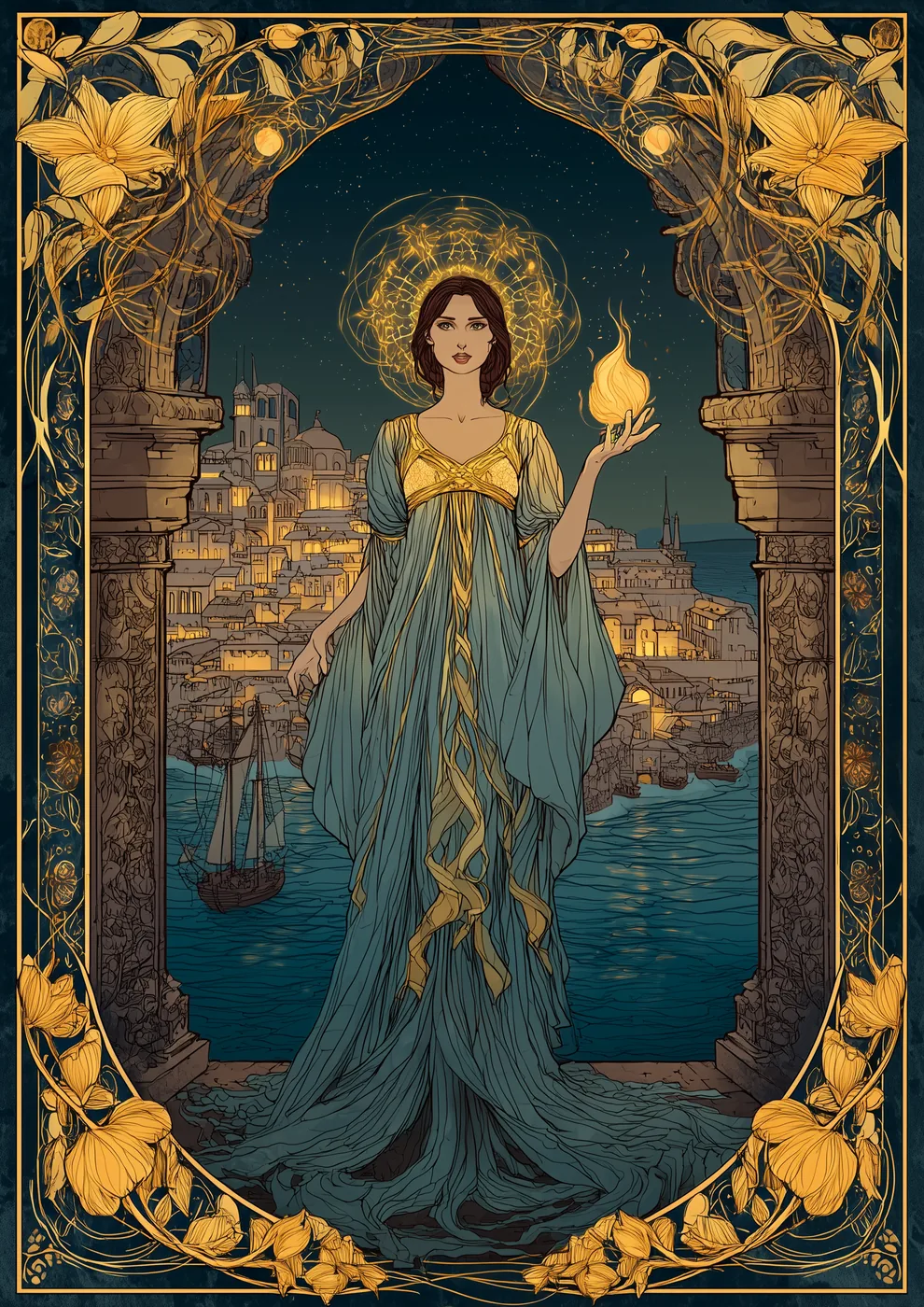
Maison Khôra is born of a shared observation: a growing share of our contemporaries lives in disenchantment, no longer able to fully inhabit the real nor to keep a living relation with life. The house conceives itself as an artistic and cultural remedy to that disenchantment — without, for all that, demanding a return to spirituality in its old and rigid forms.
Two pitfalls here await whoever would recover that living relation. The first is that of the religions of the Book and their secular avatars: all the constructions that ask an identitarian loyalty and close the Mystery with a dogma. The second, almost opposite and just as widespread, gathers everything that presents itself today as a remedy without rigour: esoteric and neo-mystical constructions, the wellness market, the personal-development industry, the generalised therapeutic offer — seductive, abundant, but cut off from the real, from the body, and from the philosophical demand that alone gives meaning.
Maison Khôra traces a third way: ecumenical, philosophical, anchored in somatic experience and in creation. A way that requires the smallest possible dose of belief — less a doctrine than a manner of standing before what exceeds us. That manner bears an old name, borrowed from the history of philosophy and not from any belonging: the apophatic way, or negative way. It does not claim to say what the Mystery is; it approaches it by removing, one by one, the images with which one would cover it — it is not this, it is not that, and what remains, after all the removals, still escapes. It is precisely that stopping point, that excess over every grasp, that we call the Mystery. Every spirituality, every religion, every mystical way is then only a cultural deposit accumulated over the centuries around that ineffable which no one ever exhausts. And this negative way, because it affirms almost nothing, is also the most universalist: it welcomes every tradition without espousing any.
Because the Mystery is ineffable, any word that claims to say it remains eminently subjective, marked by the one who has experienced it. There is no solution to the Mystery, and no doctrine closes it. What remains is a personal relation — to what exists, to creation, to the simple fact that I am here. It is this question — what does it mean to exist, and how do I stand in regard to what is? — that stands at the centre of the project, and it is the one no institution can handle in place of the person who asks it.
Maison Khôra creates the conditions for that question to be lived rather than closed: through the philosophical curriculum, through artistic creation, through direct experience in facilitated spaces, through the cultivated relation to the body and to the other. It is in this sense — civilisational more than administrative — that the house serves the public interest: an artistic and cultural project with impact, opening at the heart of the city the one space the age truly lacks.
For what is at stake far exceeds the individual. At a time when machines are learning to think, when screens hold us at once connected and separated, when wounded identities close into clans, an entire civilisation is asking what, in the human, remains irreplaceable. On this point Maison Khôra makes a limpid wager: what remains is presence — the capacity to truly look at one another, to create, to be seized by beauty, to feel the mystery of being alive. Everything no machine will ever do in our place.
It begins with something modest. A person comes in one evening, closed, tired of being alone in the midst of everything; that person leaves knowing, in their flesh, that they are held — held by other presences, held by what searches, in silence, in every existence. Multiply that instant — by a thousand encounters, by a thousand lives rekindled — and it is the fabric of an age that is rewoven. For a civilisation does not hold by its machines or its markets: it holds by the quality of presence of the beings who compose it. That is where, exactly there, Maison Khôra works.
This, at bottom, is what we propose: that in the fastest century in history, we reopen in the middle of the city the oldest and slowest space of all — the one where a life asks what it is, and finds, in the beauty of a shared instant, the beginning of an answer. To make presence a work, encounter an art, mystery a door each person remains free to cross. It is a very old fire that has to be relit. And it is in Marseille, where the light falls just so on the stone, that we undertake to tend it — with those who will want, at our side, to be its keepers.